
Pepp(er)ed Up!
Food inspiration come from everywhere for me, and nowhere more so than when I’m traveling. One of the many wonderful dishes I had when I was in Italy this summer led me to make this wonderful pasta sauce that I featured in this week’s Berkshire Eagle column.
MELLOW YELLOW
by Elizabeth Baer
I learned to eat in Italy when I was twelve years old. Obviously I don’t mean that literally. I still have the baby book my mom compiled with all the preprinted notes from the pediatrician about adding solid food when I was an infant. However, I was a picky eater. My mother always used to tell the story of how she had to hide whatever she was feeding me behind a tiny bit of applesauce. I’d taste the sweetness and open my mouth wide so she could quickly get the entire spoonful in there!
Then when I was thirteen and my sister ten, we took a family trip to Italy for an entire month. The dreamy memories of that trip remain vivid, and I also feel fortunate that I still have the journal I kept while we were there. Make no mistake, I was not brilliant or inspired or sophisticated enough to have done this of my own accord. No, our parents required us to write in our journals daily, which – no surprise – led to some epic arguments.
Almost every journal entry from that trip mentions food at least once, and upon our return, and for many years after, our parents would tell how in restaurants my sister and I would order something plain and simple, but then, upon tasting what they had ordered, we wanted to trade plates, which they always declined to do!
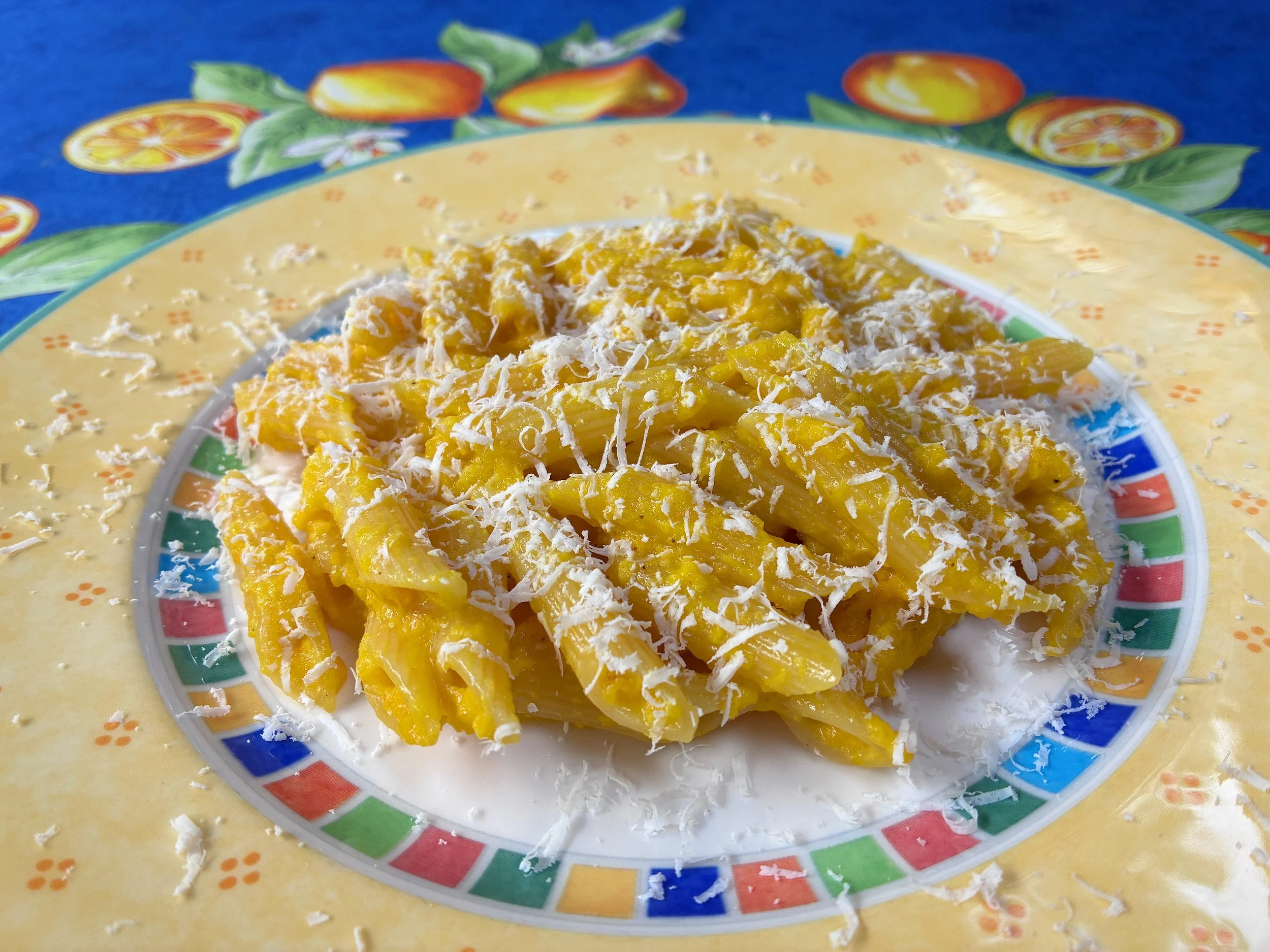
As a foodie and as a former Latin teacher, Italy holds a special place in my heart, and I have been fortunate to visit numerous times, most recently this past June for a program in Rome connected with my life as a classicist. Afterwards I visited my college friend, Dorothy, who has lived in Italy for all of her adult life. Although she was quite busy with work, during my stay in Matera, I enjoyed lunch daily with her and her husband, Antonio. One day she made a simple pasta sauce with yellow peppers, and as is often the case in Italy, good, fresh ingredients need little to be transformed into the most wonderful dishes. Dorothy used a fabulous local cheese, cacioricotta, grated over the top, but since that’s not available here, I tried ricotta salata which is a great substitute. Because that is a less common cheese choice locally, I also made it a second time with Parmesan, making sure it would still be very good.
PASTA WITH YELLOW PEPPER SAUCE
Serves 2-4, depending on whether as a side or a main course
INGREDIENTS:
3 tablespoons extra virgin olive oil
1 large or 2 medium yellow peppers, about 12 ounces total, seeds, stem, and ribs removed, chopped
1 small onion, about 2 ounces, chopped
1 teaspoon kosher salt
Plenty of fresh ground pepper
8 ounces penne or other similar shaped pasta
Grated ricotta salata or Parmesan cheese, plus more for serving
DIRECTIONS:
Heat the olive oil in a large sauté pan over medium-high heat until shimmering. Add the peppers and onion. Sprinkle with the salt and pepper. Sauté, stirring frequently, until the everything is soft and the onion is beginning to turn golden brown. If the vegetables are sticking to the pan too much, add a splash of water to loosen and stir.
When everything is fully cooked and softened, remove from the heat. Purée the vegetable mixture in a food processor or blender, or in a bowl with an immersion blender. Depending on the residual moisture in the vegetables and the device you are using, you may need to add a small amount of water. If using a blender, be sure to remove the center knob on the top and cover with a folded piece of paper towel so the purée doesn’t explode out of the top. Return the purée to the sauté pan and set aside.
Bring a pot of salted water to a boil. Add pasta and cook according to package directions for al dente. When about 2-3 minutes remain for the pasta, turn on the heat under the purée to medium and warm through, stirring from time to time and moderating the heat if necessary to prevent burning.
When the pasta is al dente, move the pasta pot right next to the sauté pan. Remove the pasta directly from the water into the sauté pan using a spider or strainer. It is important that some water cling to the pasta as that helps build the sauce. Stir to combine, and if it seems dry, add a few tablespoons of pasta water.
Serve immediately with ricotta salata or Parmesan.